Canon priority: rev3.1 primary; rev3.0 secondary; rev2.5 tertiary (most deep-history detail).
Like  Akima Ciberling being the “key-art” and “poster” character of
  🟩 RSR - Bloodtiger,
  Majora has been determined to be new the poster character for
 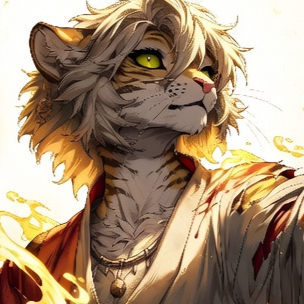 🔜 RSR ii - “Sunset”! I tried to maintain the same style!
Overview
Majora is a myth-scale figure tied to 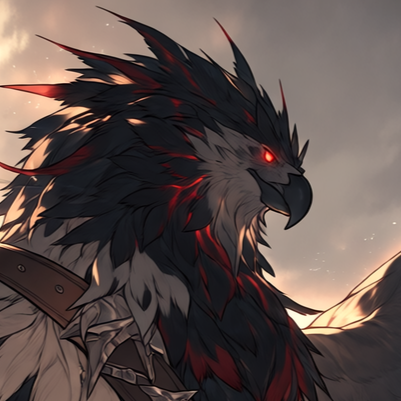 Flarion’s deep history. In old-timeline material, Majora’s companionship acts as a stabilizing force that helps keep Flarion from collapsing into the despair-state that
 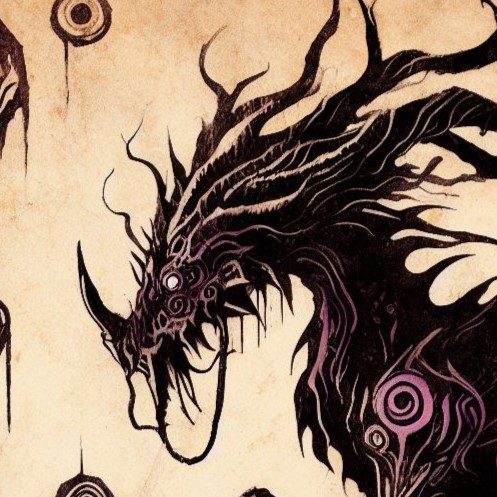 Jethro feeds on—reducing the “voice” pressure and impulse escalation without curing the infection.
Information
- Role in the myth layer: emotional stabilizer / companion to Flarion during an era when he carries “true Jethro.”
- What she is not: not a cure, not a seal, and not a “shard transmitter.” Majora’s influence is environmental/relational—she changes the host’s emotional climate.
- Why she matters: provides a narrative explanation for how a host can remain functional for long spans even while carrying a catastrophic parasitic entity.
Relationship to Flarion
Majora is described (in the old-timeline framing) as Flarion’s partner—someone he returns to and anchors around.
How they meet (old timeline; red-bordered sequence)
- Setting: Flarion meets Majora on the desert world ofQuall.
- Flarion’s state: at this point he carries “true Jethro,” but the influence is described as dormant (suppressed, not gone).
- Majora’s role: described as a gifted priestess with a form of “Templar magic,” even though the culture framing does not yet name or understand Templars as such.
- Early dynamic / pressure point: Majora’s growing strength is paired with a superiority/ambition streak (“we’re the strongest,” “we should take the galaxy”), which reads like the kind of emotional trajectory Jethro can exploit.
- Flarion’s read: he’s wary (“sus”) of what that ambition might mean in the shadow of Jethro, but stays with her anyway.
The stabilizer mechanism (reader-facing)
Majora’s companionship suppresses Jethro’s escalation by:
- Interrupting isolation: breaking the solitude that invites hopelessness.
- Defusing despair cycles: preventing long, uninterrupted spirals of guilt, grief, or purposelessness.
- Grounding identity: keeping Flarion oriented toward care, responsibility, and connection.
- Reducing fuel-state: less despair = less leverage for Jethro.
This is best understood as an attachment buffer: it doesn’t remove infection, it reduces how often the infection can take the wheel.
Connection to Jethro (deep history)
- Majora is referenced as a shard-bearer in old-timeline material.
- Even as a shard-bearer, Majora is not treated as contagious: only the true host can create shards.
- Majora’s most important impact is not “power,” but stability—she limits the conditions Jethro needs to become loud.
Legacy / echoes in the modern era
Majora’s role creates a thematic mirror for later shard-bearers:
- If attachment can buffer a host like Flarion, then Forza’s unusual resistance becomes a pointed mystery (the story flags that it is more than ordinary willpower).
- This also contextualizes why Kiara, who is isolated and grief-driven, presents a more surrender-forward profile.
 Made with Bullet