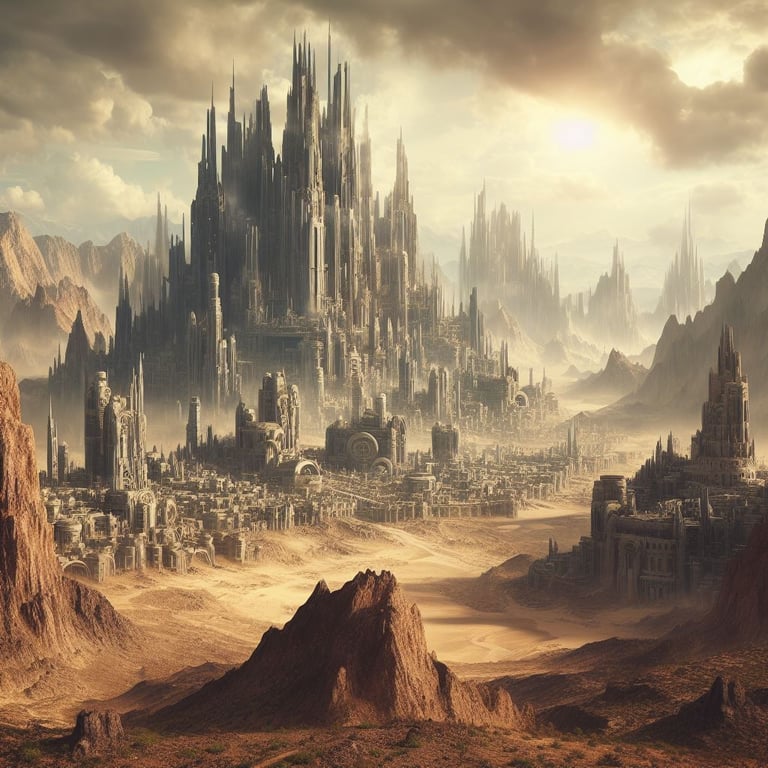
Quall is a desert planet and subterranean civilization defined by depth: cities built downward to survive sandstorms, avoid orbital surveillance, and endure siege. Its long rivalry with  Danjian power—especially the capital of
  Arken—shapes Quallian strategy, culture, and the personal arc of figures like
  Kiara Quall.
Overview
Quall’s surface settlements are deliberately modest—low sandstone facades and minimal above-ground infrastructure—while the true population centers, archives, and ritual spaces stretch through extensive underground levels. This “build down, not up” pattern is both practical (survival) and ideological (power without spectacle).
Quall’s modern history is inseparable from an entrenched interplanetary feud with Danje. The rivalry produces constant provocation—raids, sabotage, assassination attempts, and propaganda—rather than decisive conquest by either side.
The subterranean doctrine (why Quall builds downward)
On Quall, the desert is treated as an active adversary, but the surface is still real and lived-in:
- Sandstorms strip tall structures over time; anything built upward is temporary.
- Heat and exposure make surface life seasonal or limited.
- Defense-by-invisibility: what cannot be easily seen cannot be easily targeted.
As a result, Quallian cities often present:
- Functional surface neighborhoods: sandstone and light-metal buildings used day-to-day by common residents—fully serviced (power/electricity and everyday comforts), not a “poor” slum layer.
- True core below: dining halls, archives, living quarters, ritual chambers.
- Legacy depth: many abandoned sublevels beneath major sites—some collapsed, some sealed, some trapped.
A key strategic implication is resilience: the surface can be taken, burned, or glassed, yet the civilization can persist by retreating deeper or rerouting through tunnels.
Society and strategic posture
Quallian power expresses as:
- Patience and planning: long-view operations, infiltration, and leverage.
- Information advantage: secrecy as a weapon; what outsiders “see” is curated.
- Pragmatism under pressure: survival-first decisions in a hostile environment.
In contrast to Danjian “visibility culture,” Quall’s leadership and institutions tend to value outcomes over performance—winning without being witnessed is not shameful; it’s competence.
Rivalry with Danje
Quall and Danje share a solar system and therefore share:
- moons, gas clouds, ore belts, and
- continual conflict over ownership and access.
The feud’s origin is treated as effectively lost (or irrelevant), but the conflict persists as a totalizing background condition—about everything and nothing at once—kept alive through:
- historical grievance narratives,
- resource competition, and
- personal vendettas turned political.
The Systems Alliance as “mediator”
The  Systems Alliance appears historically as a distant mediator that briefly intervenes, then disengages—leaving behind weak treaties and a durable lesson: Quall and Danje are strategically “small” to the core powers, so survival is self-authored.
Notable Quallian Heritage Characters
- Kiara Quall — Quallian commander whose choices (and regrets) around the Danje conflict become foundational to the modern story’s emotional spine.
- Majora — a myth-layer Quall-linked figure (old-timeline framing) who anchors/stabilizesFlarion and provides a template for “companionship as containment.”
Story presence (RSR / WTH)
Quall is directly depicted and referenced in:
- BT - Chapter 4 — Quall’s subterranean civilization model, Danje rivalry framing, and Kiara’s strategic worldview.
- BT - Chapter 5 — A part of Quall’s capital devistated during the Sun Jin envoy “investigation,” and the inciting trauma that launches the broader conflict thread.
 Made with Bullet