The Rainru is a relic-grade Templar sword—fully usable as a frontline weapon—whose enchantment suite is optimized for containment and boundary-setting rather than ordinary lethality. It is most strongly associated with the Eveny conflicts, where it first enters the record as a “break glass” failsafe during the 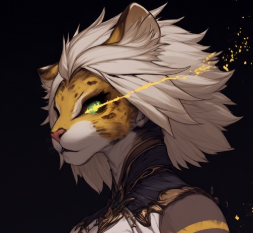 First Battle of Eveny (Majora). In later eras, it becomes a daily-driver hero-tier blade (notably carried by
  Kiara Quall after she is cured of infection), after its concealment method is exposed and it is forcibly seized during the
 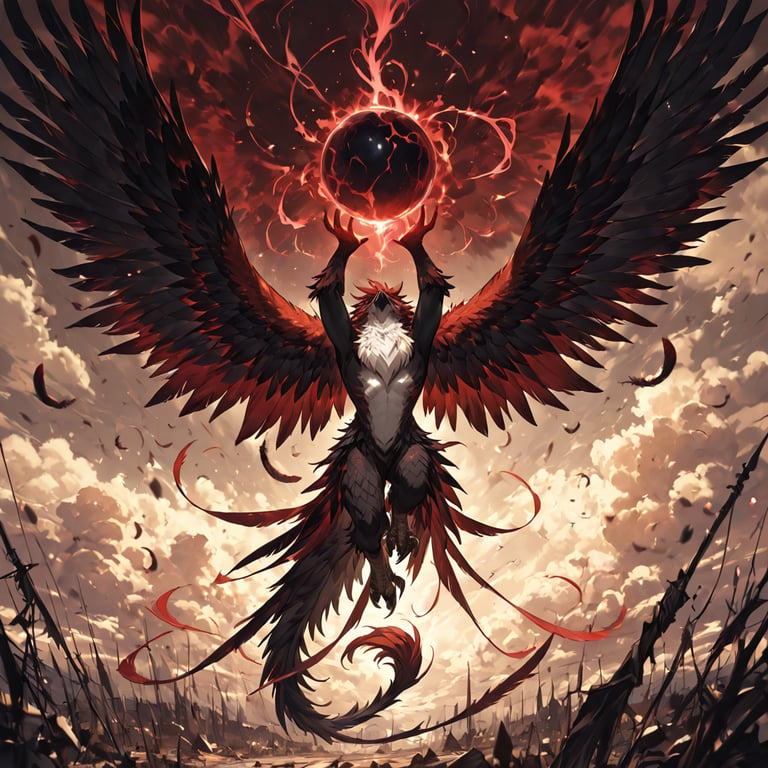 Second Battle of Eveny (Flarion).
Quick facts
- Type: Artifact (sword)
- Tier: Relic-grade / hero-tier carry
- Category: Containment-tier enchantments + fully combat-viable blade
- Origin: Forged by Tanuki after the Jethro-host era (deep history; millions of years ago)
- Sister blade: “Delrain” (purpose classified / legend-tier)
- First recorded use: First Battle of Eveny (Majora) (failsafe deployment)
- Notable later event: Second Battle of Eveny (Flarion) (method exposed; seizure and escalation)
- Later role: Primary weapon of Kiara Quall (post-cure era)
- Associated location: Eveny (especiallySanctus)
- Status: Unknown / contested after seizure (as depicted)
Creation and purpose (deep history)
Deep-history tradition attributes the Rainru’s creation to  Tanuki, forged shortly after his time as a
 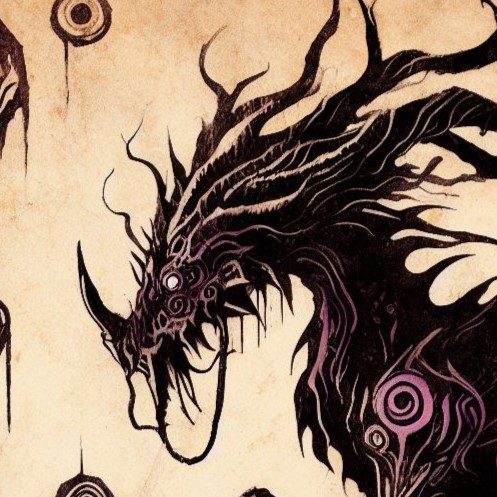 Jethro host—during the epoch when
 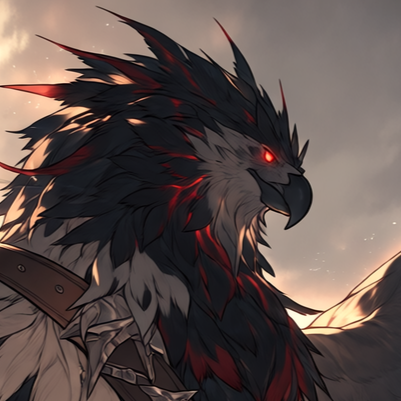 Flarion carries the burden instead (millions of years ago). In this framing, the Rainru is not a prestige weapon but a defensive answer to a specific kind of nightmare: a “never again” failsafe meant to prevent another Jethro–Tanuki-scale disaster from ever getting loose on the universe.
Tanuki’s post-host era (traditional account)
The same tradition describes a Tanuki who emerges diminished, carrying guilt for what Jethro did through them, and refocusing life around two commitments:
1) rebuilding a force for good—raising the Amber Krowen and recruiting trustworthy Templar-gifted into the Tanukian line where they can be guided and relied upon, and
2) staying planetbound on Amber Krowe—a vow to never again leave the surface, so the 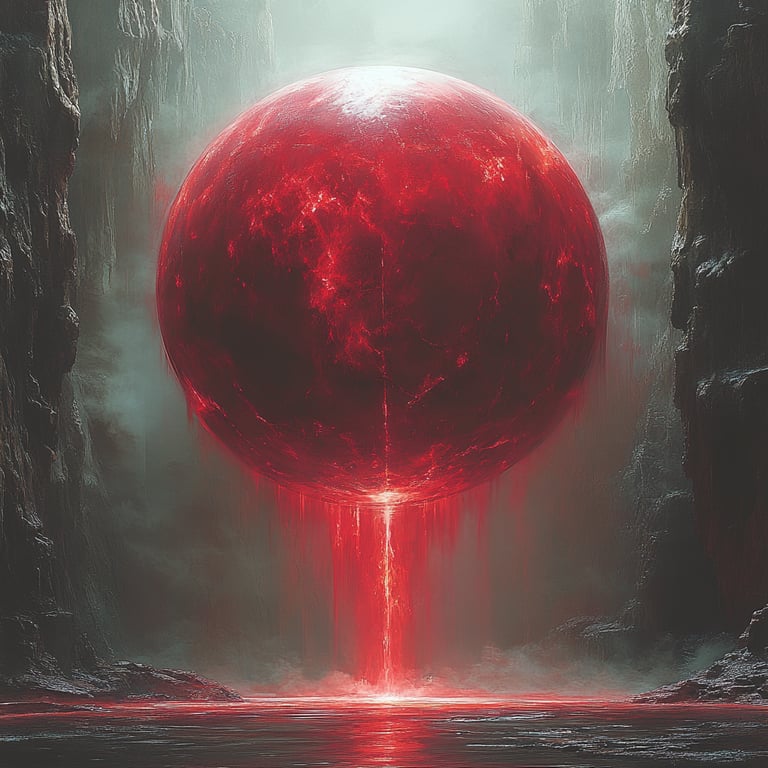 Red Matter cannot be left exposed.
In that arc, Tanuki completes a matched pair of blades:
- the Rainru, entrusted into Bezekira’s care (Neverborn custody), and
- Delrain, retained by Tanuki; its intended purpose is treated as classified—more rumor than record—often linked to the control and safeguarding of Red Matter.
Smithing method (Red Matter infusion)
The Rainru (and its sister blade) are described as being forged by imbuing fragments/essence of Red Matter into the smithing process. Tanuki is characterized as a legendary master weaponsmith, and the infusion is what grants the blades their extreme space/time-adjacent properties (the same “pocket-space” style behavior later observed in Rainru’s containment and concealment effects).
In the modern myth framing, Tanuki’s base material is the richest Varunium-bearing ore associated with Magnum’s Red Sun irradiation, then elevated further by the Red Matter infusion—positioning the Rainru and Delrain as “Red Matter Varunium” masterworks rather than ordinary Templar steel.
What it is (reader-facing)
The Rainru is best understood as a containment-tier sword: a relic-grade blade that is absolutely meant to be wielded in combat, but whose signature “edge” is the ability to impose boundaries—sealing, isolating, and removing threats from the board when killing is impossible, unsafe, or morally unacceptable.
It was made with Jethro-linked spread scenarios in mind, which is why the myth layer talks about it like an emergency failsafe. But in the main-era story it also exists as a high-end daily weapon (especially once carried by Kiara Quall post-cure), and it is treated accordingly: not a museum piece, not a locked-away device—just an exceptionally important sword with exceptionally dangerous capabilities.
What the Rainru can do (observed capabilities)
From the event writeups, the Rainru is associated with effects that resemble pocket-dimension / slipspace manipulation:
- Containment trap: In its first recorded deployment, Rainru is used to open a wormhole-like tear into slipspace and create a pocket-dimension trap that seals a target away rather than killing them outright.
- Non-local storage / concealment: In later-era handling, the sword can be hidden “inside” a person (see below), implying it can exist in a protected “elsewhere” space and be recalled near the host/key.
Because the texts emphasize containment over destruction, Rainru reads as a tool designed to remove a threat from the board when killing it would fail, worsen the spread, or be morally unacceptable.
Known hiding method (Bezzi “key” technique)
In Second Battle of Eveny (Flarion), Bezekira reveals that the Rainru can be concealed in a pocket-dimension-like void where Bezzi’s body functions as the key. Practically:
- Rainru can be “pulled” into existence within the key’s immediate proximity.
- There is no conventional vault to breach; disclosure of the method is itself a security failure.
Importantly, this concealment is a custody posture, not a statement that Rainru “isn’t a weapon.” It was hidden this way because it is strategically priceless and politically catastrophic to lose: too valuable to store conventionally, too easy to become a trophy, and too dangerous to let its location become common knowledge. The security model is secrecy + custody, not walls.
Notable events
First Battle of Eveny (Majora) — first recorded deployment
- A shard-driven break leads to a myth-scale assault on Eveny.
- Rainru is deployed as an anti-spread / anti-corruption failsafe.
- The outcome is containment by sealing the target into a pocket-dimension trap—positioning Rainru as a last resort rather than a standard weapon.
Second Battle of Eveny (Flarion) — disclosure, seizure, and escalation
- The hiding method is disclosed in Sanctus.
- A Jethro-forward manifestation of Flarion violently intrudes and forcibly extracts Rainru from the pocket space.
- The engagement escalates into multi-front conflict and culminates in the catastrophic Ezra strike, after which Rainru is removed from local control.
Narrative / setting implications
- Rainru is a power-balancing artifact: whoever controls it can change what “containment” is possible in the setting.
- Its existence implies that some threats in RSR can’t be solved by force—only by boundary-setting (sealing, removing, isolating).
- The “key” hiding method shows how artifacts can be protected by people, which also means they can be exposed by people.
See also
- First Battle of Eveny (Majora)
- Second Battle of Eveny (Flarion)
- Eveny /Sanctus
- Bezekira (custody / hiding method)
- Flarion (seizure)
- Jethro (ecology / spread pressure context)
 Made with Bullet